In the Fall of 2002, I started my first classes in the history MA at the University of Southern Mississippi, immediately after I finished my BA. It was a chaotic time – I will never forget taking my GRE, because I had a sinus infection and two infected ears, and somehow got seated at a desk where my feet didn’t touch the ground. This wasn’t a problem at first, but as I worked through the problems, I sort of… drifted. I was so dizzy by the time I finished, a friend from the department came to collect me. Then, just a couple of weeks later, I left for Europe, a scholarship in hand to allow me to complete my undergraduate with hours in a class on the Hapsburg and Hohenzollern Empires taught in Vienna and Berlin, and one on WWII taught in London and Bayeux.
On that trip, I fell in with a group of folks with whom I’ve formed lifelong friendships (and one 20+ year marriage). But I wasn’t really sure about how I’d find a home in history teaching and research, even then. I dithered, even though I started classes I enjoyed, and then… we moved.
For 20 years, I worked in higher education, married to a faculty member, and certain we’d never find jobs together in history, I refocused my efforts in sustainability and climate education for stronger communities. I found an exceptional disciplinary home, and completed an MA in Social Responsibility and Sustainable Communities, then an EdD in Community College Leadership, with a focus on community college histories.
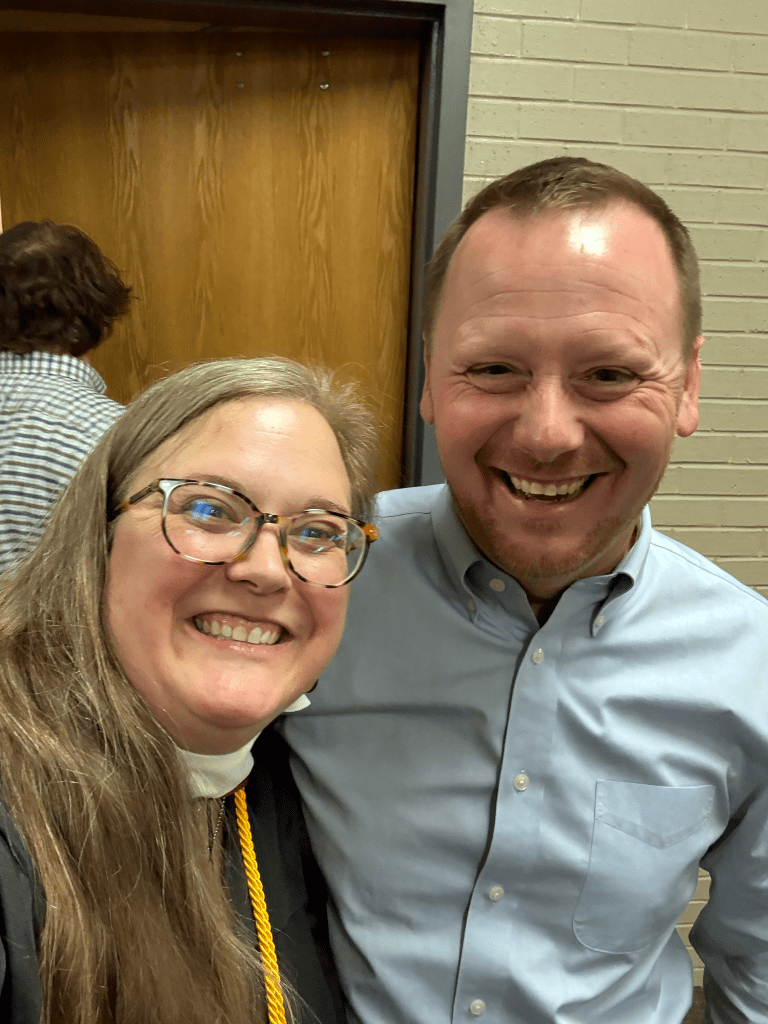
Two weeks after my defense, I talked to my chair and mentor, an historian in his own right, about maybe going back and finishing that MA I’d started all those years ago. He said what one might expect, but agreed to support me, if it’s really what I wanted. It was, and so, I enrolled.
My classes there started in the spring of 2021, and given the zeitgeist that January, I couldn’t resist signing up for a course titled American Epidemics. I took things that were well outside my other coursework – lots of work on the American South and European revolutions – and got to have far too much fun in classes on the American West, the Apollo program, and States’ Rights in the US, among others. This past April, I defended my thesis, tying up a 20-year-old loose end that’s nettled me for ages.
My work on this history MA focused on recovering the lost stories, lost names, lost experiences, lost everything of the students who integrated Mississippi Gulf Coast Junior College when it expanded to Harrison and Jackson Counties in the fall of 1965. Gulf Coast is one of the many institutions I’ve attended, and is in many ways where I also grew up. While writing, I’d briefly consulted Wright Thompson’s The Barn: The Secret History of a Murder in Mississippi, moving it to the top of my TBR pile for a very specific reason.
Wright Thompson’s work focuses on recovering the lost stories, names, involvement, and places around the kidnap and murder of Emmett Till in the Mississippi Delta during the fall of 1955. He wrote this book about his home. In it, in my reading, at least, he provides some helpful tools for critical analysis of a problem to which you’re very, very close – tools I found immensely helpful.
For a moment, while reading Thompson, we were both White Mississippians trying to uncover a past our forebears, our mentors, and in some cases our families would rather leave buried. For me, as I was writing, I kept thinking about the sort of historical exorcism I’d unwittingly found myself in, and found much support in this haunting meditation on the stories we hide in order to craft histories that comfort us.
I’m not sponsored by anyone, nor am I even read by much of anyone, that I know, but if you’ve found your way here, you should read Wright Thompson’s book. It is a must-read for anyone who knows the outlines of Emmett Till’s torturous death and what it meant for a country on the precipice of change. It should also be on your reading list for the future it portends: as we all seek new ways to preserve our past, all our past, without fear or favor.
Thompson, Wright. The Barn : The Secret History of a Murder in Mississippi. New York: Penguin Press, 2024.
 Kristy Wittman Howell